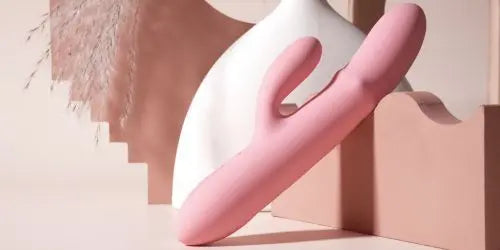
Dildos are old. Prehistoric, in fact. The best example we have is the one carved form the bluestone of what’s now southern Germany. Carved with intimate details and polished smooth, it’s dated to around 32,000 years old. Dildos are older than the invention of metal. Older than the domestication of animals. Older even than agriculture.
It’s weird, then, that nobody seems to know exactly where the word ‘dildo’ comes from. (It’s even weirder that the archeologists who keep digging up ancient dildos refer to them discreetly as ‘ice age rods’, being too polite and shame-faced to call them dildos, even they are obviously and definitely dildos.)
So let’s take a trip through etymological time, and investigate the simple question: where did the word ‘dildo’ come from? Strictly for educational purposes, obviously.
Dildos: A Sexy Phallic Enigma
The origins of the word ‘dildo’ are as slippery as the object it describes. We’ll start by looking for where it enters the historical record in English.
The earliest written record we have for the word ‘dildo’ is from Thomas Nashe, a particularly bawdy Elizabethan playwright and a contemporary of Shakespeare – in fact, a relative. Nashe was married to Shakespeare’s granddaughter. The Choice Of Valentine’s, was a satirical poem popularly known as The Merry Ballad of Nash his Dildo’.
In the play, a male character gifts his lover a ‘dilldo’ to compensate for his own poor sexual performance and premature ejaculation. The poem was deemed obscene and banned which, naturally, made it more popular, and may have singlehandedly contributed to the momentum of the word ‘dildo’ itself.
But in the same way Shakespeare had a talent for tapping into the vernacular and making subtle sexual references his audiences would understand, we can assume the word ‘dildo’ had a life in the common tongue long before it was written down. For example, English already had the word ‘dillidon’, which was a pet name something like ‘darling’, which can trace its roots right back to the much earlier Old Norse, in which ‘dilla’ meant ‘to soothe’.
The Global Spread Of Dildos
From Nashe’s use of dildo, the word flourished globally, even replacing native words for dildo in other languages. You might find refences to an olisbos in modern Greek, or a godemiche in French, but in general, most European and West-Asian languages use ‘dildo’ today.
Over time, "dildo" took on additional meanings beyond its most famous one. In some 19th-century writing, ‘dildo’ expanded its meaning to refer to anything that was fake or contrived. A scarecrow, for example, would be a dildo. That is the weirdest sentence I have ever written. It applied even to conceptual and intangible ideas too. In British politics, a policy designed to distract or mislead might be called a dildo, at least behind closed doors.
By the 18th Century, the word was common enough to be given to innocuous items that resembled dildos. We had both a dildo pear and a dildo cactus. More conservative attitudes have since prevailed, and those names have been lost.
Other Dildo Theories
While we here at Svakom are pretty confident that the origin of the word ‘dildo’ can ultimately be traced to a kind of pet-name, like ‘darling’, from Old Norse, there are a number of other theories, and even the Oxford English Dictionary contests this theory. The OED’s 2018 decision on the origin of the word ‘dildo’ is not very satisfying. It states that the word dildo “originates in nonsense syllables common in early-modern popular ballads, like “hey diddle-diddle”’.
That is, of course, rubbish, and one senses the Oxford English Dictionary of hedging its bets and being deliberately, even suspiciously, vague.
So let’s take a look at a couple of other potential dildo theories:
From Italian: Some casual observers have drawn a connection between ‘dildo’ and the Italian word ‘diletto’, meaning ‘delight’. There’s some evidence for this in medieval Italy, with some writings that euphemize sex similarly to the way English did it in the same time period.
From the Sea: ‘Dilding’ is a 16th nautical term for ‘bobbing’ on water. But one can’t help suspect, given the nature of early-modern sailors, that they may have taken influence from an existing sexual slang term, rather than the other way round.
From French: French was influential on the formation of English, and the word ‘dilater’ means much the same today as it did then: to expand something. Given the context, it seems like it would have been appropriate, but it seems unlikely to be true.
Conclusion
Sexual slang is tragically underrepresented in ‘serious’ linguistic research. Academics are simply too polite to dedicate their time and resources to investigate the etymology of words like dildo, and so it may never be solved with absolute certainty.
And that’s a terrible shame, because the way we communicate about sex and intimacy is so impossibly nuanced and idiosyncratic that real, valuable learnings can be drawn from the study of sexual language. It’s always more interesting and more revealing than we expect.
For example, the C-word, which even we are too polite to utter here, is directly related to the word ‘queen.’ That feels like it might be important, right?
To sum up today, while the Oxford English Dictionary hedges its bets, we’ll say it for them: ‘dildo’ probably comes from an Old Norse word meaning ‘to soothe’, or ‘to lull’.
Stu Nugent
Sex Toy Veteran, Ancient Mariner of the Pleasure Industry
Featured in VICERolling StoneCosmopolitanForbes
Stu Nugent is a 20-year veteran of sex toys, an ancient mariner of the pleasure industry. In that time, he has accrued unmatched experience and expertise, and has been featured in VICE, Rolling Stone magazine, Cosmopolitan, and Forbes. He has worked with all the major brands and retailers.
Stu’s commitment to honesty is complete, and his loyalty is always to the customer. Stu brings a no-BS attitude to the sex toy industry, and advocates for plain, accessible language and inclusivity in sexual health and wellness.